
In Alberta, a home needs a smoke alarm on every storey including the basement, one inside every bedroom, and one between the bedrooms and the rest of the storey, in the hallway if the bedrooms open off one (NBC(AE) 2023, 9.10.19.3). If the home has a fuel-burning appliance or an attached garage, carbon monoxide (CO) alarms go inside each bedroom or within 5 m (16 ft 5 in) of each bedroom door, measured along the halls (NBC(AE) 2023, 9.32.3.9). These are the rules of the National Building Code, 2023 Alberta Edition, second printing, in force since 17 August 2026 (Government of Alberta, 2026).
Key takeaways
- As of October 2026, every Alberta home needs a smoke alarm on each storey, basement included, in each bedroom, and in the hallway that serves the bedrooms (NBC(AE) 2023, 9.10.19.3).
- Smoke alarms must be wired to a circuit with no disconnect switch, with a battery that runs the alarm for 7 days and then 4 minutes of alarm (NBC(AE) 2023, 9.10.19.4).
- Where a home needs more than one smoke alarm, they must be interconnected so one sets off all of them, and a hush button can silence them for no more than 10 min (NBC(AE) 2023, 9.10.19.5 and 9.10.19.6).
- A home with a gas furnace, gas water heater, fireplace or attached garage needs CO alarms inside each bedroom or within 5 m (16 ft 5 in) of each bedroom door, walked along corridors and through doorways (NBC(AE) 2023, 9.32.3.9).
- CO alarms are mounted at the height the manufacturer recommends, not automatically on the ceiling, except in a room with a wood stove or other solid-fuel appliance (NBC(AE) 2023, 9.32.3.9).
- The Calgary Fire Department's home checklist goes further than the code: a smoke and a CO alarm on every level, and smoke alarms replaced once they're 10 years old (Calgary Fire Department, home fire checklist).
Where does the code require smoke alarms?
On every storey, in every bedroom, and between the bedrooms and the rest of the floor. The alarms themselves must be listed to CAN/ULC-S531 (NBC(AE) 2023, 9.10.19.1), installed to CAN/ULC-S553, and placed "on or near the ceiling" (NBC(AE) 2023, 9.10.19.3).
These are the smoke alarm locations the code sets, as of October 2026:
| Location | Rule | Clause |
|---|---|---|
| Each storey, basement included | At least one smoke alarm | 9.10.19.3.(1)(a) |
| Each bedroom | One inside the room, on any storey with bedrooms | 9.10.19.3.(1)(b) |
| Between the bedrooms and the rest of the storey | One alarm, in the hallway if a hallway serves the bedrooms | 9.10.19.3.(1)(b) |
| Mounting | On or near the ceiling | 9.10.19.3.(3) |
| Common spaces outside both units in a house with a secondary suite | Their own smoke alarms | 9.10.19.1.(1)(c) |
Note: code minimums for new homes and work under a permit, not a cap. Adding alarms beyond these is always allowed.
A floor with three bedrooms off one hall needs four alarms on that floor: one per bedroom and one in the hall. If a storey has no bedrooms, one alarm meets the code, and the Note says to put it as close to the living area as you can, because that's where most home fires start (NBC(AE) 2023, Note A-9.10.19.3.(1)). Notes are guidance, not requirements.
The City of Calgary repeats the bedroom rule on its renovation page: smoke detectors "in all bedrooms and hallways servicing bedrooms," hard-wired and interconnected "throughout the house" (The City of Calgary, 2026). A finished basement with a bedroom gets the same treatment as an upper floor.
How many smoke alarms does a split-level house need?
One per storey, not one per level, plus one for each separate sleeping area. The Note explains how to count storeys: find grade, then the first storey is "the uppermost storey having its floor level not more than 2 m above grade" (NBC(AE) 2023, Note A-9.10.19.3.(1)). Everything below it is basement, and the storeys above are counted up from there.
The Note suggests mounting each storey's alarm on its upper level. Where bedrooms sit on two levels of the same storey, both sleeping areas need an alarm outside them. In a four-level split, that usually means fewer alarms than levels, plus the extra one outside a second sleeping area.
Do smoke alarms have to be hard-wired and interconnected in Alberta?
Yes, in any building with electrical power. Smoke alarms must have a permanent connection to an electrical circuit, with no disconnect switch between the breaker and the alarm. Battery-only alarms are allowed only where the building has no electrical power (NBC(AE) 2023, 9.10.19.4).
The power and signal rules, as of October 2026:
| Requirement | Value | Clause |
|---|---|---|
| Power | Permanent connection to a circuit, no disconnect switch | 9.10.19.4.(1) |
| Battery backup | 7 days in normal condition, then 4 minutes of alarm | 9.10.19.4.(1)(c) |
| Interconnection in one home | Any alarm sets off all alarms in the unit | 9.10.19.5.(1) |
| Interconnection with a secondary suite | Wireless or hard-wired, all alarms in both units sound | 9.10.19.5.(2) |
| Sound | Temporal alarm pattern, or temporal pattern with voice | 9.10.19.2 |
| Hush button | Silences for not more than 10 min, then resets | 9.10.19.6 |
Note: the code's requirements for installed alarms. Electrical work needs its own permit from the City of Calgary.
The City adds a detail for suites: where alarms sit on a circuit with arc-fault or ground-fault protection, they need an integral 10-year battery as the backup (The City of Calgary, 2026). The fire separation that goes with a suite is on the secondary suite fire separation guide.
Where do carbon monoxide alarms go in Alberta?
Near the bedrooms, in any home with something that can make CO. The rule applies to any residential building that contains a fuel-burning appliance or a storage garage (NBC(AE) 2023, 9.32.3.9). A gas furnace or water heater counts, and so does an attached garage, even in an all-electric house.
The Note gives the reason for the garage rule. Several cases of CO from garages drawn into houses show that "a fully gas-tight barrier is difficult to achieve," and running exhaust fans or simply heating the house can pull garage air in (NBC(AE) 2023, Note A-9.32.3.9).
Where the CO alarms go depends on where the source is, as of October 2026:
| Situation | Where the CO alarm goes | Clause |
|---|---|---|
| Fuel-burning appliance inside the home | Inside each bedroom, or outside within 5 m (16 ft 5 in) of each bedroom door, measured along corridors and through doorways | 9.32.3.9.(4) |
| Appliance in a service room outside the home, sharing a wall or floor with it | The same 5 m rule in the home, plus one in the service room | 9.32.3.9.(5) |
| Home sharing a wall or floor with a garage, or an attic or crawl space with it | The same 5 m rule | 9.32.3.9.(6) |
| Room with a wood stove or other solid-fuel appliance | In that room, at the maker's height for solid fuel, otherwise on or near the ceiling | 9.32.3.9.(3) |
| House with a secondary suite | Wired so any CO alarm sets off all of them | 9.32.3.9.(7) |
Note: code minimums. The alarms must be CSA 6.19 devices with their own sounder, wired with no disconnect switch where they run on house power, and fixed at the height the manufacturer recommends.
That last point trips people up. Smoke alarms go on or near the ceiling; CO alarms go wherever the instructions say, which can be lower on the wall. Read the alarm's instructions before the electrician places its box.
What does the 5 m rule look like on a floor plan?
It's a walking distance, not a circle. The 5 m (16 ft 5 in) is measured "following corridors and doorways" (NBC(AE) 2023, 9.32.3.9), so a CO alarm that's close through a wall can still be too far by the hall.
The drawing is an upper floor 9 000 mm by 6 600 mm with three bedrooms off one hall. It has a smoke alarm (S) in each bedroom and one in the hall, and a single CO alarm in the hall that sits within 5 000 mm, walked along the hall, of all three bedroom doors (the short bars on the hall wall).
If the bedrooms were spread across two halls, one CO alarm might not reach every door within 5 m, and you'd need a second, or one inside each bedroom. The City of Calgary's suite page asks for CO alarms "centrally located" and within 5 m (16 ft 5 in) of any bedroom (The City of Calgary, 2026).
Does the City of Calgary ask for more than the code?
Its fire department advises more. The Calgary Fire Department's home checklist asks for at least one smoke alarm and one CO alarm on every level of the home, monthly testing, and replacing smoke alarms "that are more than 10 years old" (Calgary Fire Department, home fire checklist). That's advice for any home, not a permit condition.
Bedroom placement shapes the rest of the floor too. The bedroom size guide and egress window guide cover what else a room needs to count as a bedroom.
Seeing the alarm layout at full size
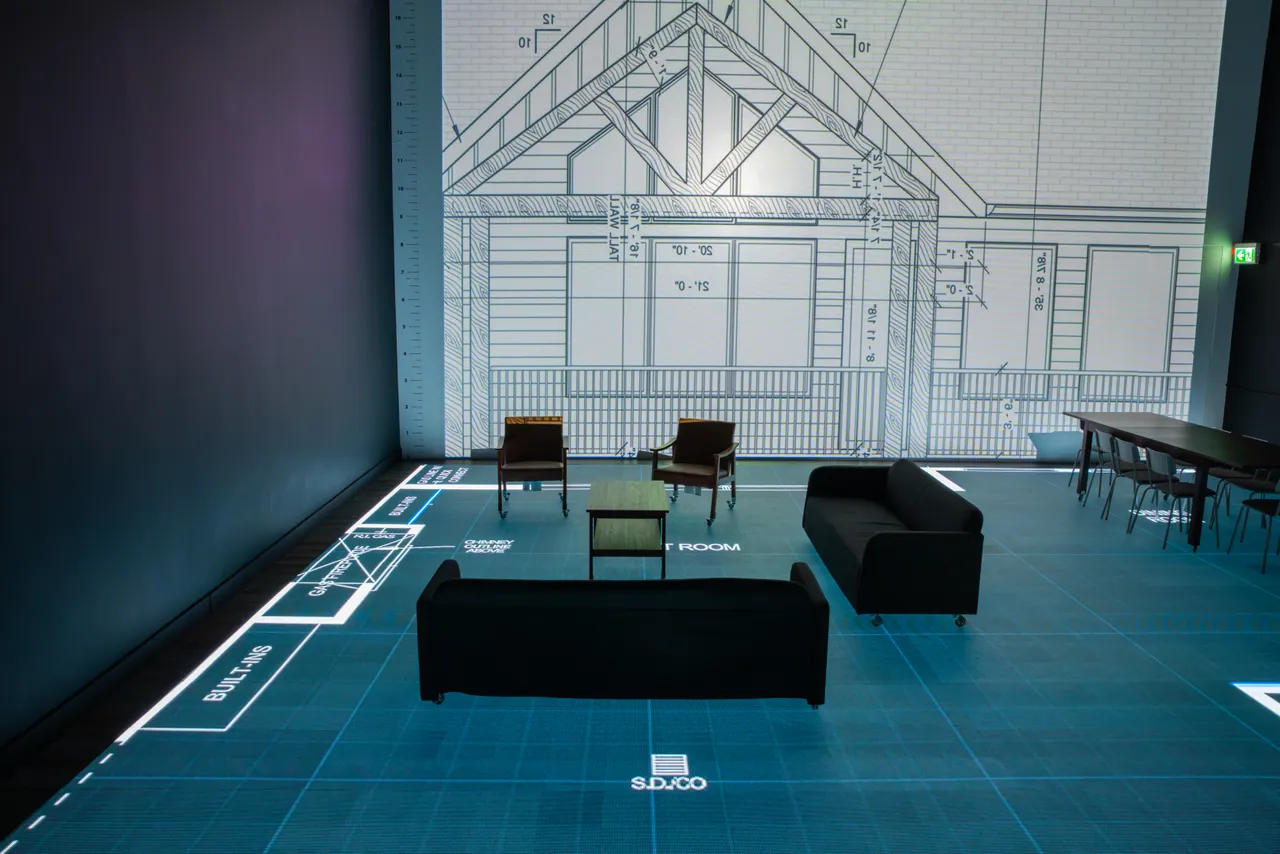
At 1to1 Plans Calgary, your floor plan is shown at full size on a walkable LED floor, room by room, with room names and dimension lines. You can walk from a planned CO alarm to each bedroom door and see whether the route stays inside 5 m, and check that each hall alarm sits where the bedrooms meet the rest of the floor. Changes are made on the spot.
Sessions are quoted for the plan, and the quote is free (see pricing). See how a session works, the other building code guides, or book a session.
Questions
Do you need a smoke alarm in every bedroom in Alberta?
Yes. In Alberta, every bedroom needs its own smoke alarm, plus one in the hallway or area between the bedrooms and the rest of that storey, as of October 2026. Every storey, the basement included, needs at least one.
Where should a carbon monoxide detector go in an Alberta house?
In an Alberta house with a fuel-burning appliance or an attached garage, a carbon monoxide alarm goes inside each bedroom or within 5 m (16 ft 5 in) of each bedroom door. The 5 m is walked along the corridors and through doorways, not measured straight through walls.
Do smoke alarms have to be hard-wired in Alberta?
Yes, where the building has electrical power. In Alberta, smoke alarms need a permanent connection to a circuit with no disconnect switch, and a battery that keeps them working for 7 days and then sounds for 4 minutes.
Does an all-electric house need a carbon monoxide alarm in Alberta?
Only if it has an attached garage or another fuel-burning source. In Alberta, the CO alarm rule applies to homes with a fuel-burning appliance or a storage garage, so an all-electric house with a detached garage and no fireplace isn't covered by it.
How high should a carbon monoxide alarm be mounted?
In Alberta, a carbon monoxide alarm is mounted at the height its manufacturer recommends. The exception is a room with a wood stove or other solid-fuel appliance, where the alarm goes on or near the ceiling if the instructions don't say otherwise.
Sources
- NBC(AE) 2023, 9.10.19.3 nrc-publications.canada.ca
- Government of Alberta, 2026 alberta.ca
- Calgary Fire Department, home fire checklist calgary.ca
- The City of Calgary, 2026 calgary.ca
- The City of Calgary, 2026 calgary.ca